
Build the wall set
Art, frame, light and hanging gear, picked together. Choose a size and finish; the wall preview shows exactly what you're getting. One button sends the whole kit to your Amazon cart.
Amazon sells the physical items, sets their prices and availability, and may pay us a commission. The free museum file is separate. How we get paid →
How big can you print it?
Standard frame sizes, turned to match the artwork. "Crops" is how much of the picture you lose filling that frame edge to edge — or keep it all and let a mat take up the difference.
| Frame | Effective dpi | Verdict | Crops |
|---|---|---|---|
| 8 × 10 in | 333 | Gallery sharp | nothing |
| 11 × 14 in | 238 | Sharp up close | 1% |
| 12 × 16 in | 209 | Sharp up close | 6% |
| 16 × 20 in | 166 | Poster sharp | nothing |
| 18 × 24 in | 139 | Fine across a room | 6% |
| 24 × 36 in | 92 | Too soft | 16% |
| 30 × 40 in | 83 | Too soft | 6% |
The ticket
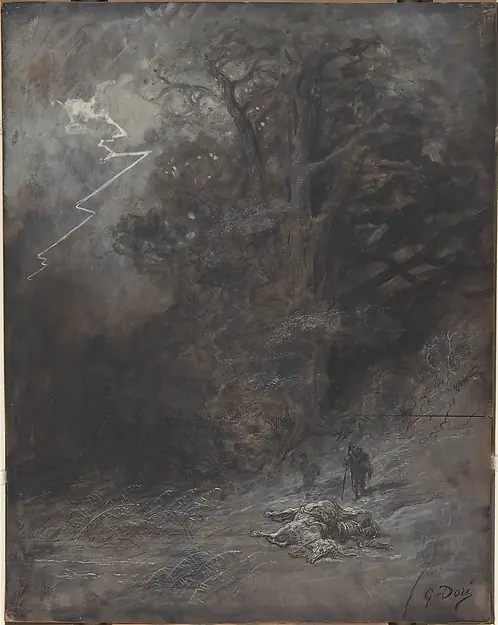
A Rider and a Dead Horse in a Landscape is a woodblock print by Gustave Doré (French, Strasbourg 1832–1883 Paris). Pen and black ink, brush and black wash, heightened with white on woodblock. Size on the museum record: 9 5/16 x 7 3/8 in. (23.6 x 18.7 cm). The Metropolitan Museum of Art holds it in its Drawings and Prints collection — Gift of Charles H. Cryan, 1977.
In The Met's records, A Rider and a Dead Horse in a Landscape is a pen and black ink, brush and black wash, heightened with white on woodblock credited to Gustave Doré. The museum gives no firm date for it, and files it under accession 1977.543 in Drawings and Prints. The subject is a view, and the eye travels from the foreground to the distance; give it wall space so that route stays readable. The Met's scan measures 2,667 × 3,345 pixels, which prints about 8.9 × 11.2 in at 300 dpi and 17.8 × 22.3 in at a still-comfortable 150 dpi. Because it runs tall, it wants a vertical frame; compare the crop percentage across sizes before you choose. It is close to monochrome, so the frame sets the mood: black for contrast, white for air, or a thin natural wood for warmth. Woodblock prints were made to be reproduced, so a faithful reprint fits the tradition. Keep the paper tone warm instead of bleaching it to white. A warm picture light a few inches above the frame does more for a print than any paper upgrade, and the hanging centre line belongs near 57 inches.
The Met released its scan under CC0, which means no permission, no fee and no credit line required. That file is 2,667 × 3,345 pixels — 8.9 megapixels — good for a gallery-sharp print up to 8.9 × 11.2 in. That is bigger than the woodblock print itself, which measures about 7.4 × 9.3 in — the file holds more detail than you can see standing in front of the original.Woodblock prints were made to be printed again and again — a reproduction is in keeping with the whole point of the thing. Keep the paper tone warm. A printer that bleaches the ground to white-white flattens it into clip art.
On the receipt
- Artist
- Gustave Doré
- Medium
- Pen and black ink, brush and black wash, heightened with white on woodblock
- Size
- 9 5/16 x 7 3/8 in. (23.6 x 18.7 cm)
- Museum
- The Met · Drawings and Prints
- Accession
- 1977.543
- License
- Public domain · CC0 1.0
- Source
- Museum record ↗
More Gustave Doré
All 10 →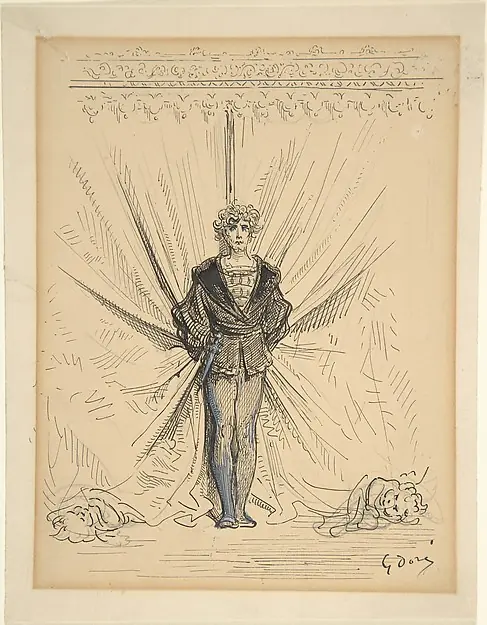 A Costumed Actor in Front of a CurtainFree · sharp to 9 × 11.5 in at 300 dpi, uncropped
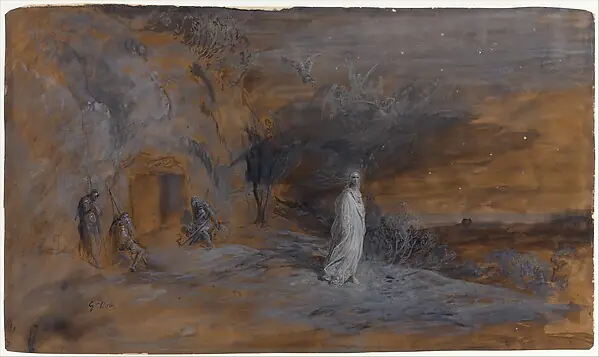 Christ Leaving the Tomb1869Free · sharp to 12.7 × 7.6 in at 300 dpi, uncropped
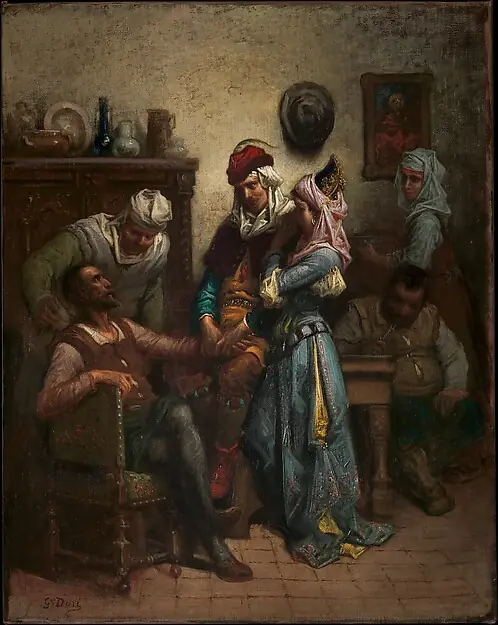 Don Quixote and Sancho Panza Entertained by Basil and Quiteria1863?Free · sharp to 10.3 × 12.9 in at 300 dpi, uncropped
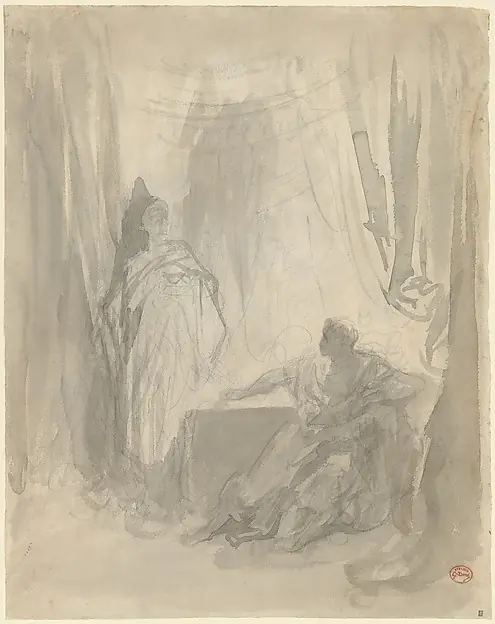 L'Apparition1850–83Free · sharp to 10.1 × 12.8 in at 300 dpi, uncropped