
Build the wall set
Art, frame, light and hanging gear, picked together. Choose a size and finish; the wall preview shows exactly what you're getting. One button sends the whole kit to your Amazon cart.
Amazon sells the physical items, sets their prices and availability, and may pay us a commission. The free museum file is separate. How we get paid →
How big can you print it?
Standard frame sizes, turned to match the artwork. "Crops" is how much of the picture you lose filling that frame edge to edge — or keep it all and let a mat take up the difference.
| Frame | Effective dpi | Verdict | Crops |
|---|---|---|---|
| 8 × 10 in | 363 | Gallery sharp | nothing |
| 11 × 14 in | 259 | Sharp up close | 2% |
| 12 × 16 in | 227 | Sharp up close | 6% |
| 16 × 20 in | 181 | Poster sharp | nothing |
| 18 × 24 in | 151 | Poster sharp | 6% |
| 24 × 36 in | 100 | Fine across a room | 17% |
| 30 × 40 in | 90 | Too soft | 6% |
The ticket
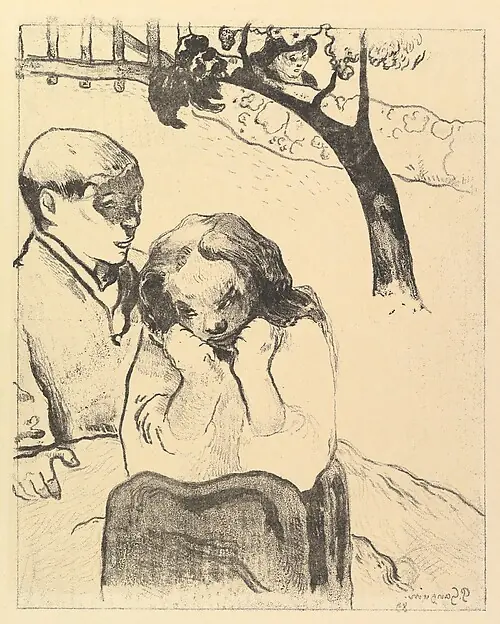
Human Misery, from the Volpini Suite: Dessins lithographiques is a painting by Paul Gauguin (French, Paris 1848–1903 Atuona, Hiva Oa, Marquesas Islands), dated 1889. zincograph, on simili-Japan paper; second edition. Size on the museum record: 11 9/16 x 9 5/16 in. (29.4 x 23.7 cm). The Metropolitan Museum of Art holds it in its Drawings and Prints collection — Bequest of Scofield Thayer, 1982.
In The Met's records, Human Misery, from the Volpini Suite: Dessins lithographiques is a zincograph, on simili-japan paper; second edition credited to Paul Gauguin. The museum dates it 1889, and files it under accession 1984.1203.47 in Drawings and Prints. Spend a minute with the composition before choosing a size: notice where the eye lands first and where it rests. The Met's scan measures 2,912 × 3,633 pixels, which prints about 9.7 × 12.1 in at 300 dpi and 19.4 × 24.2 in at a still-comfortable 150 dpi. Its tall proportions suit a hallway, a narrow wall or the gap beside a door, and the set builder shows how much each standard frame would crop. Its muted earth tones are forgiving: natural wood softens the palette, walnut deepens it and black frames it like a gallery. Paintings reproduce best on matte paper, since gloss throws glare across exactly the brushwork you came for. Add a small picture light and keep the centre of the piece around 57 inches from the floor; those two choices make a reproduction look deliberate.
The Met released its scan under CC0, which means no permission, no fee and no credit line required. That file is 2,912 × 3,633 pixels — 10.6 megapixels — good for a gallery-sharp print up to 9.7 × 12.1 in. That is roughly life-size: the painting itself measures about 9.3 × 11.6 in.Paintings reproduce best on matte paper. Gloss throws glare across exactly the brushwork you came for, and a picture light does more for a print than any upgrade in paper.
On the receipt
- Artist
- Paul Gauguin
- Date
- 1889
- Medium
- zincograph, on simili-Japan paper; second edition
- Size
- 11 9/16 x 9 5/16 in. (29.4 x 23.7 cm)
- Museum
- The Met · Drawings and Prints
- Accession
- 1984.1203.47
- License
- Public domain · CC0 1.0
- Source
- Museum record ↗
More Paul Gauguin
All 14 →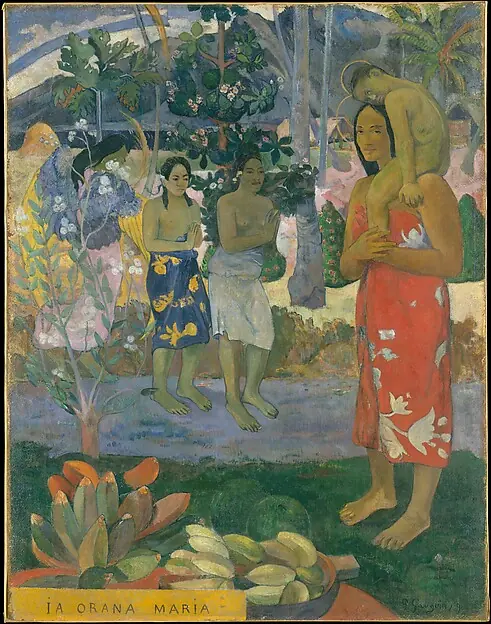 Ia Orana Maria (Hail Mary)1891Free · sharp to 9.8 × 12.4 in at 300 dpi, uncropped
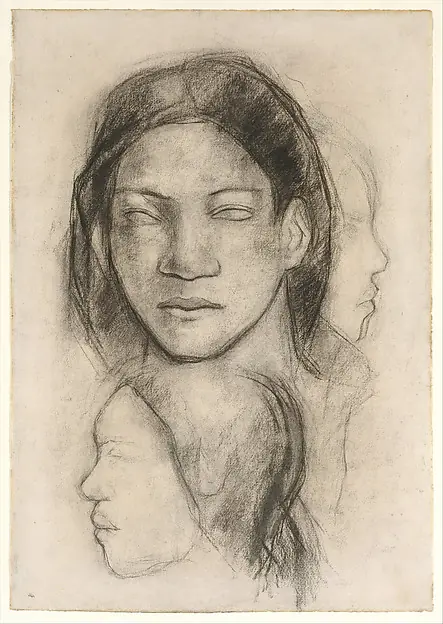 Tahitian Faces (Frontal View and Profiles)ca. 1899Free · sharp to 8.8 × 12.4 in at 300 dpi, uncropped
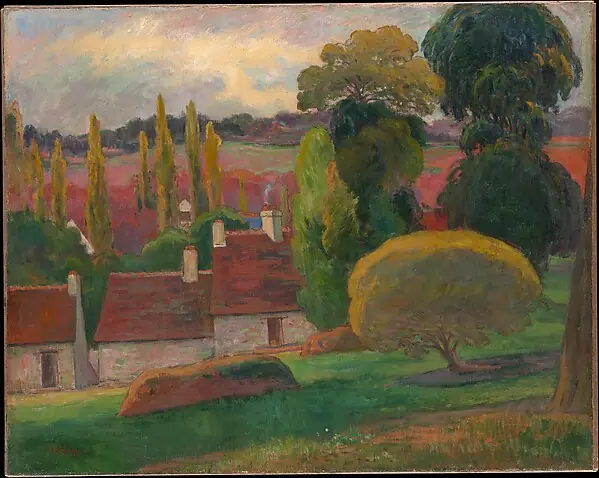 A Farm in Brittanyca. 1894Free · sharp to 12.9 × 10.3 in at 300 dpi, uncropped
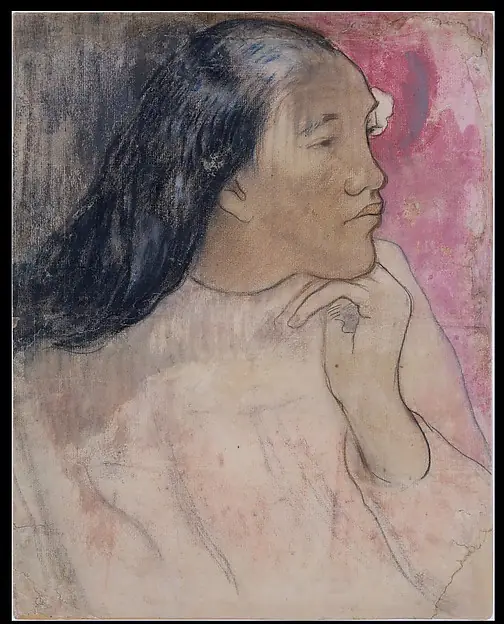 A Tahitian Woman with a Flower in Her Hair1891–92Free · sharp to 10.3 × 12.7 in at 300 dpi, uncropped