
Build the wall set
Art, frame, light and hanging gear, picked together. Choose a size and finish; the wall preview shows exactly what you're getting. One button sends the whole kit to your Amazon cart.
Amazon sells the physical items, sets their prices and availability, and may pay us a commission. The free museum file is separate. How we get paid →
How big can you print it?
Standard frame sizes, turned to match the artwork. "Crops" is how much of the picture you lose filling that frame edge to edge — or keep it all and let a mat take up the difference.
| Frame | Effective dpi | Verdict | Crops |
|---|---|---|---|
| 10 × 8 in | 359 | Gallery sharp | 19% |
| 14 × 11 in | 256 | Sharp up close | 21% |
| 16 × 12 in | 224 | Sharp up close | 24% |
| 20 × 16 in | 179 | Poster sharp | 19% |
| 24 × 18 in | 149 | Fine across a room | 24% |
| 36 × 24 in | 99 | Too soft | 33% |
| 40 × 30 in | 89 | Too soft | 24% |
The ticket
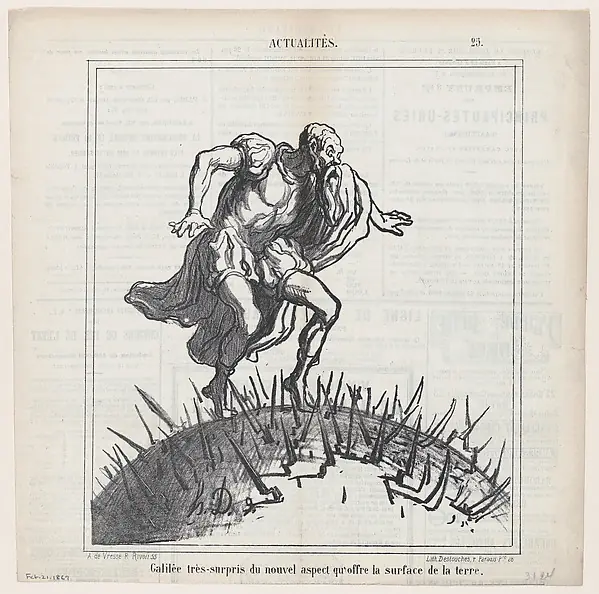
Galileo, astonished by changes in the face of the earth, from "News of the Day" is a print by Honoré Daumier (French, Marseilles 1808–1879 Valmondois), dated February 21, 1867. Lithograph on newsprint; second state of two (Delteil). Size on the museum record: Image: 9 5/8 × 8 7/16 in. (24.4 × 21.4 cm) Sheet: 11 1/2 × 11 3/8 in. (29.2 × 28.9 cm). The Metropolitan Museum of Art holds it in its Drawings and Prints collection — Harris Brisbane Dick Fund, 1936.
Galileo, astonished by changes in the face of the earth, from "News of the Day" is a lithograph on newsprint; second state of two (delteil) by Honoré Daumier, part of The Met's open-access collection. The museum dates it February 21, 1867 (accession 36.12.63, Drawings and Prints). Spend a minute with the composition before choosing a size: notice where the eye lands first and where it rests. The Met's scan measures 3,590 × 3,559 pixels, which prints about 12.0 × 11.9 in at 300 dpi and 23.9 × 23.7 in at a still-comfortable 150 dpi. Its near-square shape is unusual for stock frames, so look at the square sizes first and accept a little crop or margin elsewhere. It is close to monochrome, so the frame sets the mood: black for contrast, white for air, or a thin natural wood for warmth. Line work lives on contrast. Print it on smooth bright paper and give it a wider frame or mat so the fine marks are not swallowed. Light it from above with a soft warm bulb, hang the centre of the picture near 57 inches, and it will read as intended instead of as decoration.
The Met released its scan under CC0, which means no permission, no fee and no credit line required. That file is 3,590 × 3,559 pixels — 12.8 megapixels — good for a gallery-sharp print up to 12 × 11.9 in. That is bigger than the print itself, which measures about 8.4 × 9.6 in — the file holds more detail than you can see standing in front of the original.Line work lives or dies on contrast. Print it on a smooth, bright paper and give it a wide mat: small graphic work drowns in a thin frame and a big empty border makes it look like it came out of a print room drawer.
On the receipt
- Artist
- Honoré Daumier
- Date
- February 21, 1867
- Medium
- Lithograph on newsprint; second state of two (Delteil)
- Size
- Image: 9 5/8 × 8 7/16 in. (24.4 × 21.4 cm) Sheet: 11 1/2 × 11 3/8 in. (29.2 × 28.9 cm)
- Museum
- The Met · Drawings and Prints
- Accession
- 36.12.63
- License
- Public domain · CC0 1.0
- Source
- Museum record ↗
More Honoré Daumier
All 14 →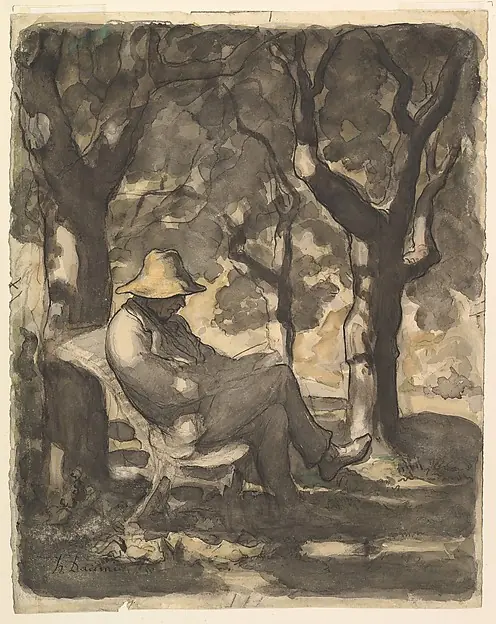 A Man Reading in a Garden (recto); Preliminary sketch for a Man Reading in a Garden (verso)ca. 1865Free · sharp to 9.6 × 12.1 in at 300 dpi, uncropped
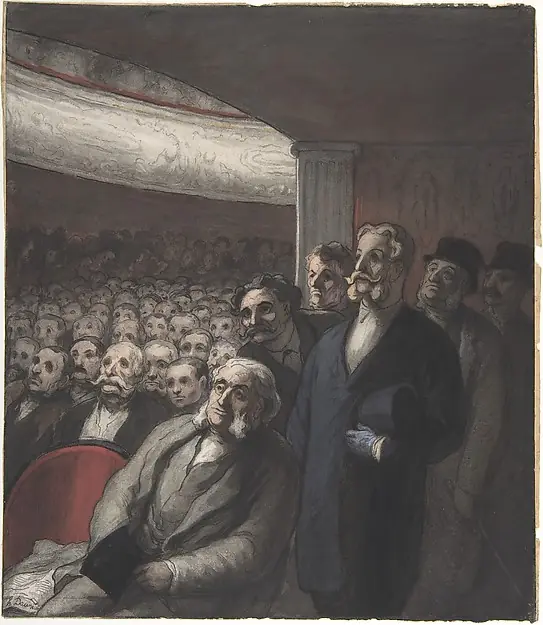 A Theater Audience19th centuryFree · sharp to 9.1 × 10.5 in at 300 dpi, uncropped
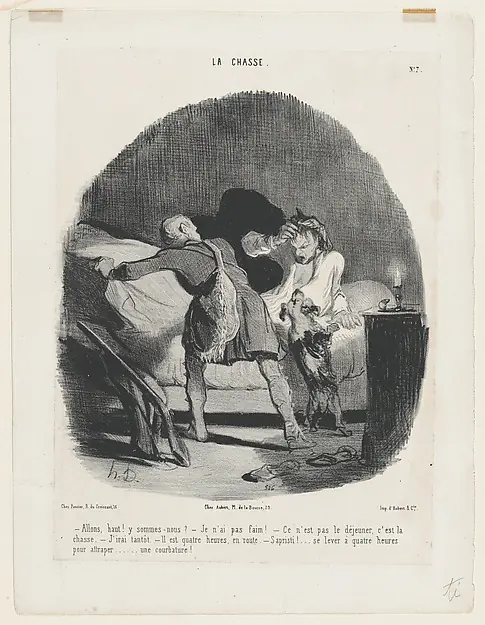 Allons haut! Y sommes-nous?, from "La Chasse"November 11, 1843Free · sharp to 9.4 × 12.1 in at 300 dpi, uncropped
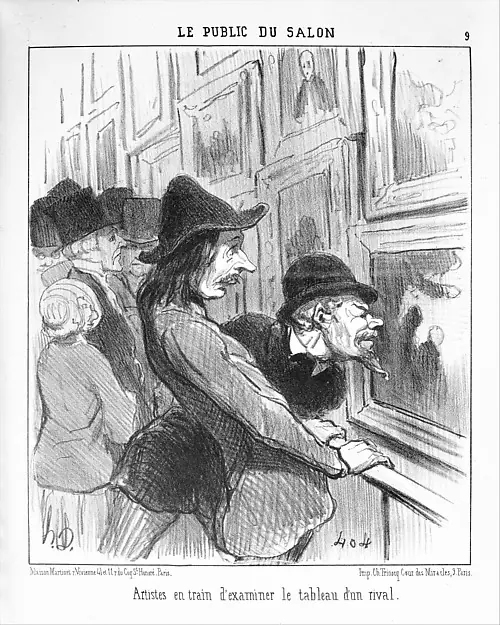 Artists Examining the Work of a Rival (Artistes en train d'examiner le tableau d'un rival), from Le Public du Salon, published in "Le Charivari"May 14, 1852Free · sharp to 9.9 × 12.4 in at 300 dpi, uncropped