
Build the wall set
Art, frame, light and hanging gear, picked together. Choose a size and finish; the wall preview shows exactly what you're getting. One button sends the whole kit to your Amazon cart.
Amazon sells the physical items, sets their prices and availability, and may pay us a commission. The free museum file is separate. How we get paid →
How big can you print it?
Standard frame sizes, turned to match the artwork. "Crops" is how much of the picture you lose filling that frame edge to edge — or keep it all and let a mat take up the difference.
| Frame | Effective dpi | Verdict | Crops |
|---|---|---|---|
| 8 × 10 in | 400 | Gallery sharp | 9% |
| 11 × 14 in | 285 | Sharp up close | 10% |
| 12 × 16 in | 250 | Sharp up close | 14% |
| 16 × 20 in | 200 | Sharp up close | 9% |
| 18 × 24 in | 166 | Poster sharp | 14% |
| 24 × 36 in | 111 | Fine across a room | 24% |
| 30 × 40 in | 100 | Fine across a room | 14% |
The ticket
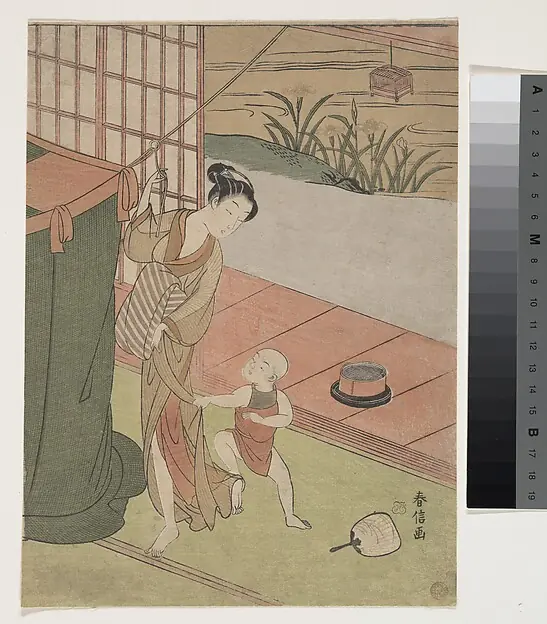
Mother and Son by a Mosquito Net is a woodblock print by Suzuki Harunobu (Japanese, 1725–1770), dated ca. 1769. Woodblock print; ink and color on paper. Size on the museum record: 10 3/4 x 7 15/16 in. (27.3 x 20.2 cm) medium-size print (chu-ban). The Metropolitan Museum of Art holds it in its Asian Art collection — Purchase, Joseph Pulitzer Bequest, 1918.
Mother and Son by a Mosquito Net is a woodblock print; ink and color on paper by Suzuki Harunobu, part of The Met's open-access collection. The museum dates it ca. 1769 (accession JP565, Asian Art). The subject is a person, so the face is the anchor. Hang it with the eyes near the centre line instead of floating high on the wall. The Met's scan measures 3,505 × 4,000 pixels, which prints about 11.7 × 13.3 in at 300 dpi and 23.4 × 26.7 in at a still-comfortable 150 dpi. Its tall proportions suit a hallway, a narrow wall or the gap beside a door, and the set builder shows how much each standard frame would crop. Its muted earth tones are forgiving: natural wood softens the palette, walnut deepens it and black frames it like a gallery. Woodblock prints were made to be reproduced, so a faithful reprint fits the tradition. Keep the paper tone warm instead of bleaching it to white. A warm picture light a few inches above the frame does more for a print than any paper upgrade, and the hanging centre line belongs near 57 inches.
The Met released its scan under CC0, which means no permission, no fee and no credit line required. That file is 3,505 × 4,000 pixels — 14 megapixels — good for a gallery-sharp print up to 11.7 × 13.3 in. That is bigger than the woodblock print itself, which measures about 8 × 10.7 in — the file holds more detail than you can see standing in front of the original.Woodblock prints were made to be printed again and again — a reproduction is in keeping with the whole point of the thing. Keep the paper tone warm. A printer that bleaches the ground to white-white flattens it into clip art.
On the receipt
- Artist
- Suzuki Harunobu
- Date
- ca. 1769
- Medium
- Woodblock print; ink and color on paper
- Size
- 10 3/4 x 7 15/16 in. (27.3 x 20.2 cm) medium-size print (chu-ban)
- Museum
- The Met · Asian Art
- Accession
- JP565
- License
- Public domain · CC0 1.0
- Source
- Museum record ↗
More Suzuki Harunobu
All 14 →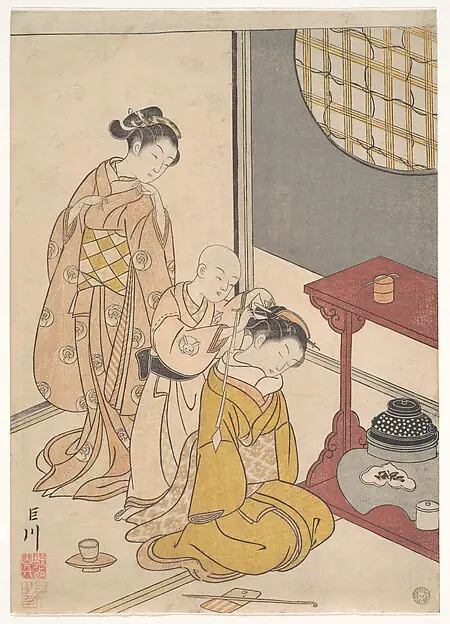 Night Rain at the Double-Shelf Stand, from the series Eight Parlor Views (Zashiki hakkei)ca. 1766Free · sharp to 9.5 × 13.1 in at 300 dpi, uncropped
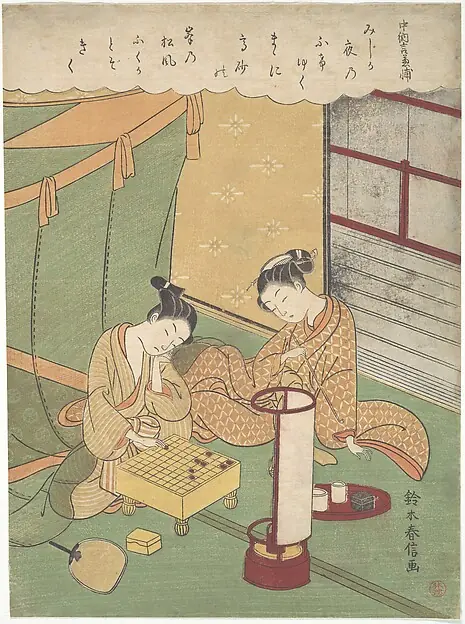 A Young Woman and Man Playing Shōgi (Japanese Chess); Chūnagon Kanesuke, from a series alluding to the Thirty-Six Poetic Immortals (Sanjūrokkasen)ca. 1767–69Free · sharp to 9.5 × 12.8 in at 300 dpi, uncropped
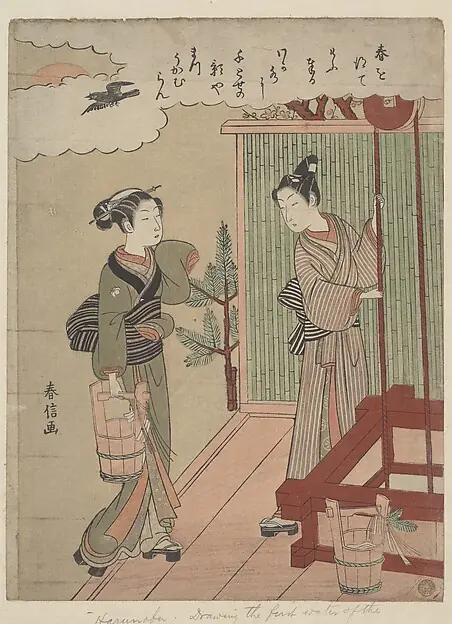 Drawing the First Water of the New Yearca. 1769–70Free · sharp to 9.7 × 13.3 in at 300 dpi, uncropped
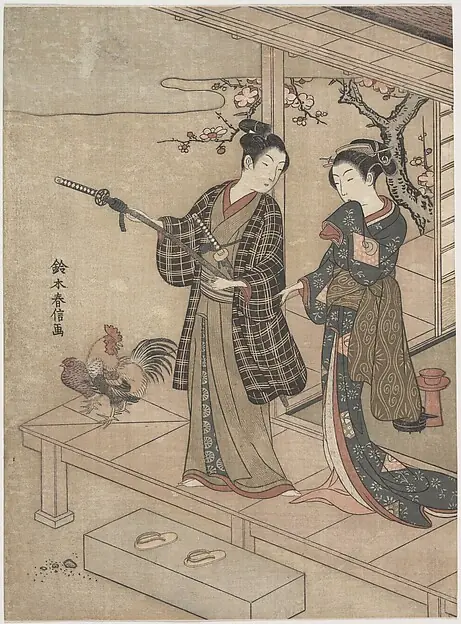 Gentleman Taking Leave of His Lady on a VerandaFree · sharp to 9.2 × 12.4 in at 300 dpi, uncropped