
Build the wall set
Art, frame, light and hanging gear, picked together. Choose a size and finish; the wall preview shows exactly what you're getting. One button sends the whole kit to your Amazon cart.
Amazon sells the physical items, sets their prices and availability, and may pay us a commission. The free museum file is separate. How we get paid →
How big can you print it?
Standard frame sizes, turned to match the artwork. "Crops" is how much of the picture you lose filling that frame edge to edge — or keep it all and let a mat take up the difference.
| Frame | Effective dpi | Verdict | Crops |
|---|---|---|---|
| 10 × 8 in | 165 | Poster sharp | 14% |
| 14 × 11 in | 120 | Fine across a room | 13% |
| 16 × 12 in | 110 | Fine across a room | 9% |
| 20 × 16 in | 82 | Too soft | 14% |
| 24 × 18 in | 73 | Too soft | 9% |
| 36 × 24 in | 53 | Too soft | 3% |
| 40 × 30 in | 44 | Too soft | 9% |
The ticket
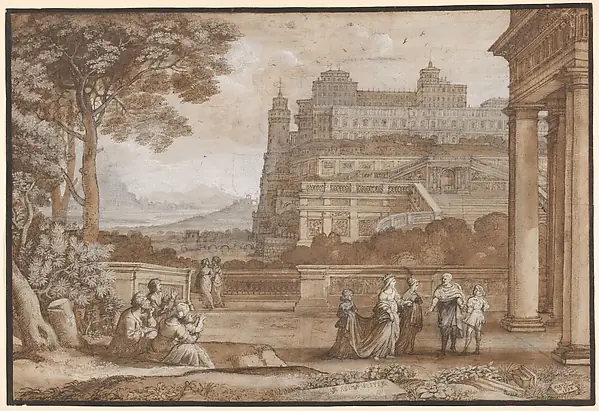
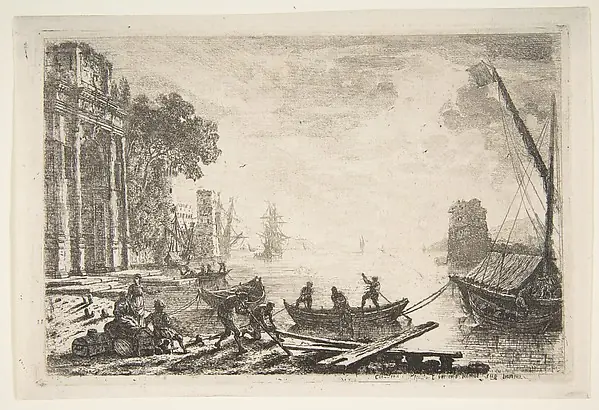
Queen Esther Approaching the Palace of Ahasuerus is a work on paper by Claude Lorrain (Claude Gellée) (French, Chamagne 1604/5?–1682 Rome), dated 1658. Pen and brown ink, brush and brown wash, heightened with white, over black chalk. Size on the museum record: 11 13/16 x 17 1/2 in. (30 x 44.4 cm). The Metropolitan Museum of Art holds it in its Drawings and Prints collection — Purchase, The Annenberg Foundation Gift, 1997.
The Met catalogs Queen Esther Approaching the Palace of Ahasuerus as a pen and brown ink, brush and brown wash, heightened with white, over black chalk by Claude Lorrain (Claude Gellée). The museum dates it 1658 (accession 1997.156, Drawings and Prints). The subject is a person, so the face is the anchor. Hang it with the eyes near the centre line instead of floating high on the wall. The Met's scan measures 1,927 × 1,322 pixels, which prints about 6.4 × 4.4 in at 300 dpi and 12.8 × 8.8 in at a still-comfortable 150 dpi. Its wide proportions sit naturally over a sofa, console or bed, and the crop figures in the set builder show what a standard frame would trim. Its warm reds and oranges suit walnut or gold, which deepen the glow instead of washing it out. Works on paper are quiet. Print near the original's scale instead of blowing it up, and keep it out of direct sun like the museum does. Add a small picture light and keep the centre of the piece around 57 inches from the floor; those two choices make a reproduction look deliberate.
The Met released its scan under CC0, which means no permission, no fee and no credit line required. That file is 1,927 × 1,322 pixels — 2.5 megapixels — good for a gallery-sharp print up to 6.4 × 4.4 in. The work on paper itself measures about 17.5 × 11.8 in, so a true life-size print runs below 300 dpi — still sharp at normal viewing distance.Works on paper are quiet. Print near the original’s size rather than blowing it up, mat it generously, and keep it out of direct sun — the same rules the museum follows for the real one.
On the receipt
- Artist
- Claude Lorrain (Claude Gellée)
- Date
- 1658
- Medium
- Pen and brown ink, brush and brown wash, heightened with white, over black chalk
- Size
- 11 13/16 x 17 1/2 in. (30 x 44.4 cm)
- Museum
- The Met · Drawings and Prints
- Accession
- 1997.156
- License
- Public domain · CC0 1.0
- Source
- Museum record ↗
More Claude Lorrain
All 14 →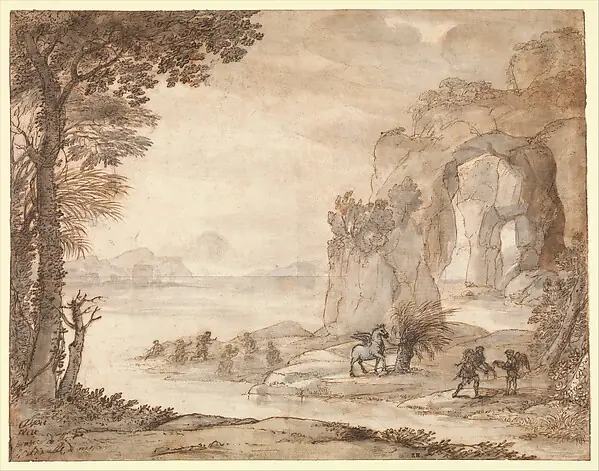 Perseus and the Origin of Coralca. 1671Free · sharp to 13 × 10.2 in at 300 dpi, uncropped
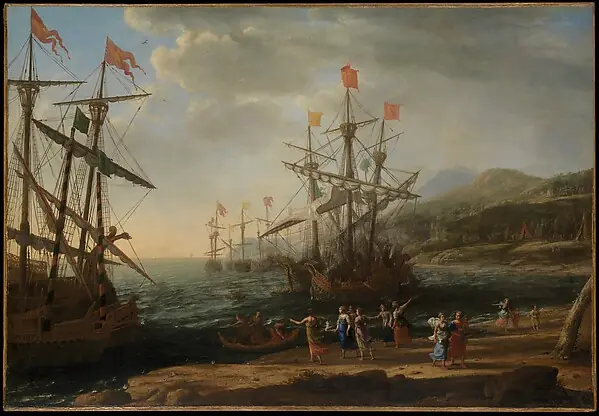 The Trojan Women Setting Fire to Their Fleetca. 1643Free · sharp to 13.1 × 9.1 in at 300 dpi, uncropped
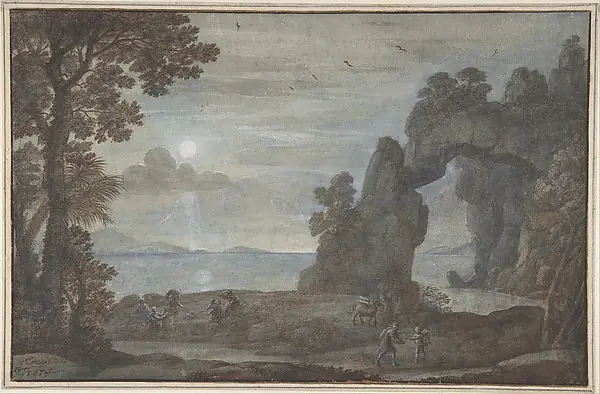 Coast View with Perseus and the Origin of Coral1674Free · sharp to 12.9 × 8.5 in at 300 dpi, uncropped
 Harbor Scene with Rising Sun1634Free · sharp to 13.3 × 9.1 in at 300 dpi, uncropped