
Build the wall set
Art, frame, light and hanging gear, picked together. Choose a size and finish; the wall preview shows exactly what you're getting. One button sends the whole kit to your Amazon cart.
Amazon sells the physical items, sets their prices and availability, and may pay us a commission. The free museum file is separate. How we get paid →
How big can you print it?
Standard frame sizes, turned to match the artwork. "Crops" is how much of the picture you lose filling that frame edge to edge — or keep it all and let a mat take up the difference.
| Frame | Effective dpi | Verdict | Crops |
|---|---|---|---|
| 8 × 10 in | 347 | Gallery sharp | 13% |
| 11 × 14 in | 248 | Sharp up close | 15% |
| 12 × 16 in | 217 | Sharp up close | 19% |
| 16 × 20 in | 173 | Poster sharp | 13% |
| 18 × 24 in | 144 | Fine across a room | 19% |
| 24 × 36 in | 96 | Too soft | 28% |
| 30 × 40 in | 86 | Too soft | 19% |
The ticket
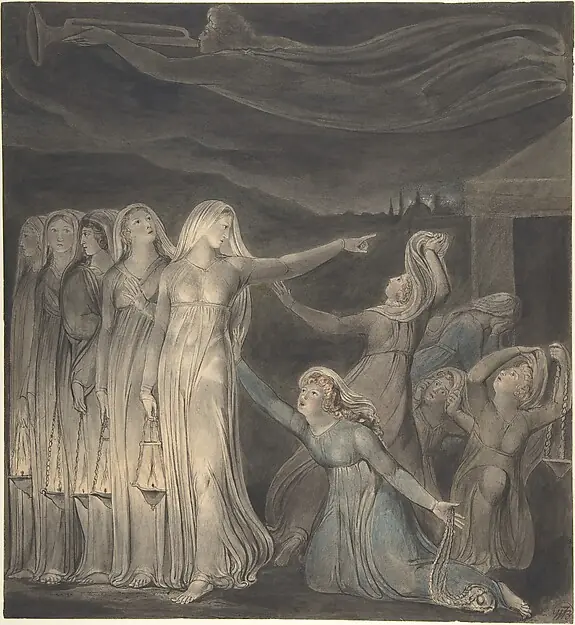
The Parable of the Wise and Foolish Virgins is a work on paper by William Blake (British, London 1757–1827 London), dated ca. 1799–1800. Watercolor, pen and black ink, brush and wash, over graphite. Size on the museum record: Sheet: 14 3/16 × 13 1/16 in. (36 × 33.2 cm). The Metropolitan Museum of Art holds it in its Drawings and Prints collection — Rogers Fund, 1914.
The Parable of the Wise and Foolish Virgins is a watercolor, pen and black ink, brush and wash, over graphite by William Blake, part of The Met's open-access collection. The museum dates it ca. 1799–1800, and files it under accession 14.81.2 in Drawings and Prints. Spend a minute with the composition before choosing a size: notice where the eye lands first and where it rests. The Met's scan measures 3,198 × 3,475 pixels, which prints about 10.7 × 11.6 in at 300 dpi and 21.3 × 23.2 in at a still-comfortable 150 dpi. Its near-square shape is unusual for stock frames, so look at the square sizes first and accept a little crop or margin elsewhere. It is close to monochrome, so the frame sets the mood: black for contrast, white for air, or a thin natural wood for warmth. Works on paper are quiet. Print near the original's scale instead of blowing it up, and keep it out of direct sun like the museum does. Light it from above with a soft warm bulb, hang the centre of the picture near 57 inches, and it will read as intended instead of as decoration.
The Met released its scan under CC0, which means no permission, no fee and no credit line required. That file is 3,198 × 3,475 pixels — 11.1 megapixels — good for a gallery-sharp print up to 10.7 × 11.6 in. The work on paper itself measures about 13.1 × 14.2 in, so a true life-size print runs below 300 dpi — still sharp at normal viewing distance.Works on paper are quiet. Print near the original’s size rather than blowing it up, mat it generously, and keep it out of direct sun — the same rules the museum follows for the real one.
On the receipt
- Artist
- William Blake
- Date
- ca. 1799–1800
- Medium
- Watercolor, pen and black ink, brush and wash, over graphite
- Size
- Sheet: 14 3/16 × 13 1/16 in. (36 × 33.2 cm)
- Museum
- The Met · Drawings and Prints
- Accession
- 14.81.2
- License
- Public domain · CC0 1.0
- Source
- Museum record ↗
More William Blake
All 14 →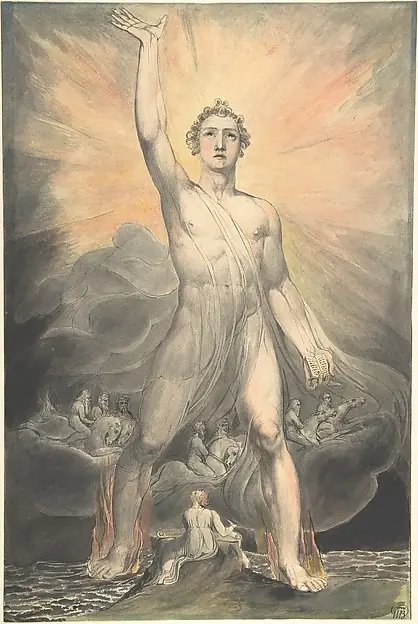 Angel of the Revelation (Book of Revelation, chapter 10)ca. 1803–5Free · sharp to 8.1 × 12.1 in at 300 dpi, uncropped
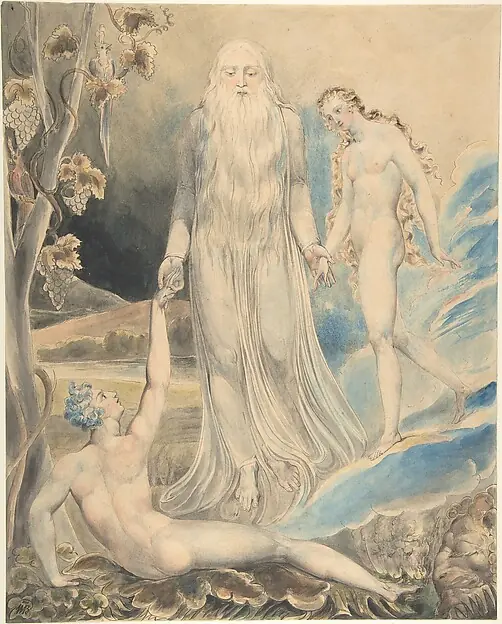 Angel of the Divine Presence Bringing Eve to Adam (The Creation of Eve: "And She Shall be Called Woman) (recto); Sketch for the same (verso)ca. 1803Free · sharp to 9.8 × 12.2 in at 300 dpi, uncropped
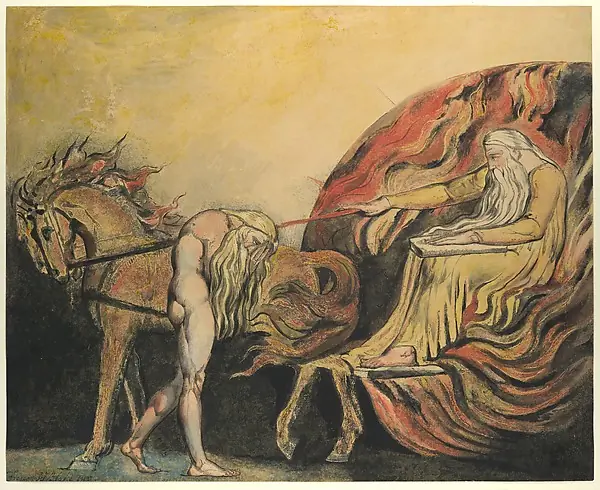 God Judging Adamca. 1795Free · sharp to 13.3 × 10.9 in at 300 dpi, uncropped
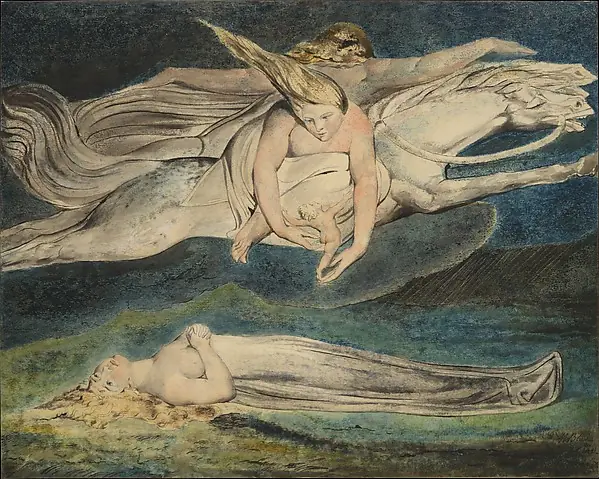 Pityca. 1795Free · sharp to 12.3 × 9.8 in at 300 dpi, uncropped